
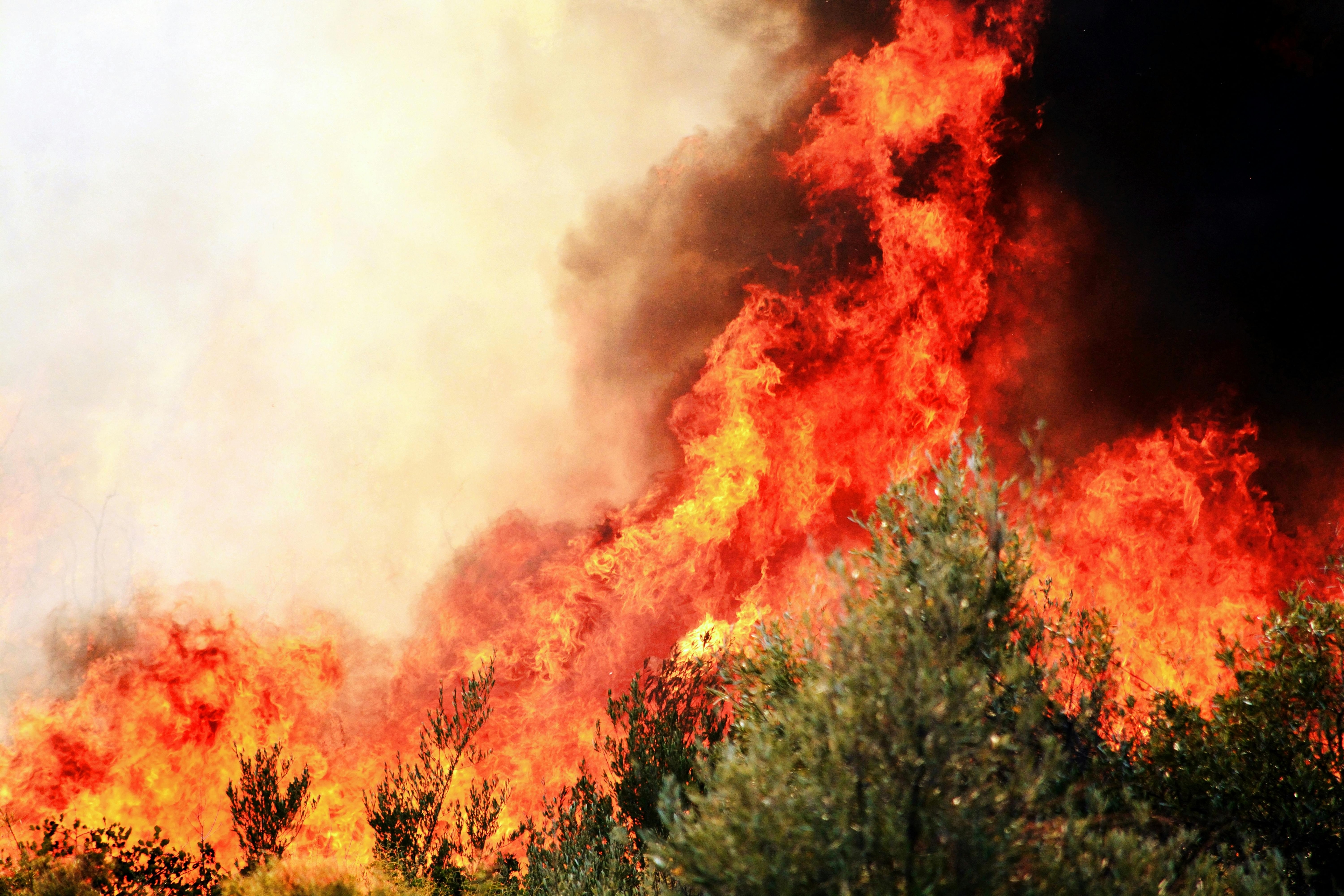
Wildfire and Fire Weather: The Emerging UK Property Risk
Author
Stephen Sykes
Date Published
For many of us living in Britain, wildfire still sounds like something that happens somewhere else: California, Greece, Spain or Australia. It brings to mind scorched hillsides, evacuated villages and dramatic television footage from hotter, drier countries.
However, with a changing climate, this view is becoming a little outmoded.
Emerging research on the record-breaking European fire season of 2025 identifies the UK as having its highest annual burned area since the European Forest Fire Information System record began in 2006.
One of the striking features of the UK’s 2025 wildfire season was not simply that it was severe. It was that it arrived so early. In western and northern Britain, wildfire activity peaked in early April, with major fires in Galloway Forest Park in Scotland and Ystrad Fflur in Wales.
Hence, wildfire is not just a summer heatwave problem. In the UK, spring can matter just as much: dry vegetation, low rainfall, wind and human activity can combine to create serious fire conditions too.
For property professionals, that will prompt a shift in how the issue is understood.
The Law Society context
The Law Society’s Climate Change and Property Practice Note, and its Supplementary Technical Note, list wildfire as an important example of a physical climate risks that may affect property transactions.
The Law Society guidance points towards early consideration of climate risk, clear communication with clients, and appropriate signposting where specialist information is needed. Wildfire sits within that framework.
The key point is not that solicitors should become climate scientists, meteorologists or fire specialists to assess this risk; rather it is that climate-related hazards like wildfire (or fire weather: see below) can affect property values, use, insurability, marketability, lending and client decision-making.
What the Climate Change Committee says
The Climate Change Committee (CCC) put the issue in stark terms in its May 2026 report, A Well-Adapted UK: The Fourth Independent Assessment of UK Climate Risk.
The CCC states that 2025 was the UK’s most destructive wildfire season on record, with more than 40,000 hectares burned.
It also warns that high fire-risk days could double by 2050, that the wildfire season is expected to lengthen, and that wildfire hazards which occur only occasionally today could be experienced in most years.
For property professionals, the CCC report is important because it places wildfire within the same wider climate-risk landscape as overheating, flooding, drought, water scarcity and infrastructure resilience.
Wildfire and Fire Weather
A wildfire is an uncontrolled fire in vegetation. In the UK, that may mean moorland, heathland, grassland, woodland, scrub, agricultural land or the edge between development and open countryside.
Fire weather is a different but incredibly useful concept. It refers to the weather conditions that make vegetation fires more likely to ignite, spread or become difficult to control.
In plain English, fire weather is the combination of heat, wind and dryness. High temperatures dry vegetation. Low rainfall and drought reduce fuel moisture. Wind spreads flames. Dry air draws moisture out of vegetation and dead fuels.
That distinction is important: wildfire is the event, whereas fire weather is the set of conditions that can make wildfire more likely or more severe.
For climate searches and property reporting, the issue should not be framed as a prediction that a particular property will or will not be affected by wildfire. That would overstate what the available data can show.
The more useful question is whether wildfire is becoming a more likely physical climate risk for the location, the surrounding landscape and the client’s decision - i.e. the extent to which fire weather is becoming more likely.
Recent research findings
The record-breaking 2025 European Fire Season to Climate Change report, reinforces the CCC’s warning.
It identifies several countries, including the United Kingdom, as having their highest annual burned area since the European Forest Fire Information System (EFFIS) record began in 2006.
For Britain, the paper is particularly useful because it draws attention to the spring character of wildfire in some UK landscapes. It notes that fire occurrence often peaks in spring in northern and western parts of Great Britain, and that the greatest burned area occurs in mountain, bog and heath landscapes.
The 2025 spring event was associated with drought and low fuel moisture.
The paper also notes that nearly all UK wildfires are started by people, although the precise causes are not always investigated or recorded in detail. That is an important point for property risk.
Wildfire is not determined by vegetation and weather alone. It is also shaped by how people use the landscape. Footpaths, roads, access land, recreation areas, visitor pressure, disposable barbecues, cigarettes, machinery and deliberate fire-setting can all affect the chance of ignition. In other words, people matter: where they live, walk, travel, gather and recreate can influence whether a fire starts in the first place.
That makes wildfire a more complex issue than a map of vegetation alone.
Why is land cover not the only important factor in wildfire?
Land cover means the physical surface of the land: for example, woodland, grassland, heathland, moorland, scrub, farmland, gardens, roads, buildings or open urban land. In wildfire terms, land cover matters because it helps identify where combustible vegetation may be present.
But land cover is only one part of the risk picture.
Wildfire risk is shaped by a combination of landscape, weather, human activity and climate trend. Vegetation matters. Land management matters. The interface between development and combustible vegetation matters. However, none of these factors, taken in isolation, tells the whole story.
A property is not automatically at material wildfire risk simply because there is vegetation nearby. Equally, a location should not be assumed to have no relevant exposure simply because it is not in an obviously remote or rural setting.
.jpg&w=3840&q=100)
Picture of Wennington, Essex after the devastating 2022 wildfire - picture under licence from Creative Commons, Harrison Healey.
Wennington, on the eastern edge of London, shows us why. On 19 July 2022, during the UK’s record-breaking heatwave, fire spread from dry grassland into the village. Around 18–19 homes were destroyed and residents were evacuated.
This was not a fire in a distant forest or an isolated moorland landscape. It was a London-edge event, where extreme heat, dry vegetation, buildings and human settlement met in the wrong conditions.
That is the wider lesson for property due diligence. Wildfire risk is not only a countryside issue. It can also be an edge-of-settlement issue: the point where homes, gardens, fences, sheds, access roads and open land meet dry combustible vegetation.
The risk depends on context: what the land is used for, how it is managed, how dry it is, how people access it, whether ignition sources are likely, how weather conditions are changing, and how close buildings and infrastructure are to combustible vegetation. A simple rural / urban divide is therefore too crude.
Why this matters for conveyancing and property reports
For solicitors and property advisers, the main challenge is communication.
Clients need information that is clear, practical and expressed in plain English, without overstating the risk or causing unnecessary alarm
They need to know whether wildfire is relevant to the property or asset they are considering. They also need to understand what the available information can and cannot show.
The Law Society framework points towards proportionate reporting. Solicitors should not overstate specialist environmental or climate information. They should also avoid ignoring physical climate risks where those risks may be relevant.
A proportionate climate-risk report should help the client understand whether wildfire is relevant to the property or surrounding area, what factors may be driving that relevance, and what the assessment does (and does not) show.
It should make clear that wildfire risk is influenced by changing weather conditions, vegetation, land use, human activity and the relationship between development and the surrounding landscape. It should also explain that the assessment identifies relevant risk factors and changing conditions; it is not a prediction that a particular property will be affected by wildfire.
Asking Smarter Questions
The lesson from 2025 is not that every property now faces wildfire risk. That would be wrong and alarmist.
It is that wildfire, and the fire-weather conditions that can drive it, have become a more visible part of the UK’s physical climate-risk landscape.
The timing of the 2025 fires is important. A record year shaped in part by spring conditions shows that wildfire risk in the UK can be influenced by spring drought, dry vegetation, wind, land use and human ignition. It is not only a high-summer issue.
Hence, for property due diligence purposes, the key question should not be: will this property be impacted by a wildfire? That implies a level of certainty that the available information cannot support.
The smarter question is: are wildfire and fire-weather conditions becoming more relevant over time to this location?
That is a far more sensible question for solicitors, clients, lenders and property professionals. It keeps the focus on relevance, context and proportionate climate risk reporting.
A property should not be treated as being at material wildfire risk simply because there is vegetation nearby. Likewise, a location should not be assumed to have no relevant exposure simply because it is not in an obviously remote or rural setting.
TerraIQ has been working on an innovative new Fire Weather dataset, as part of its Climate Hazard Suite, which will shortly be released. This will enable conveyancers, land and asset managers to better understand and support future risk exposure to potential wildfires.
For more information and a demo, get in touch today.